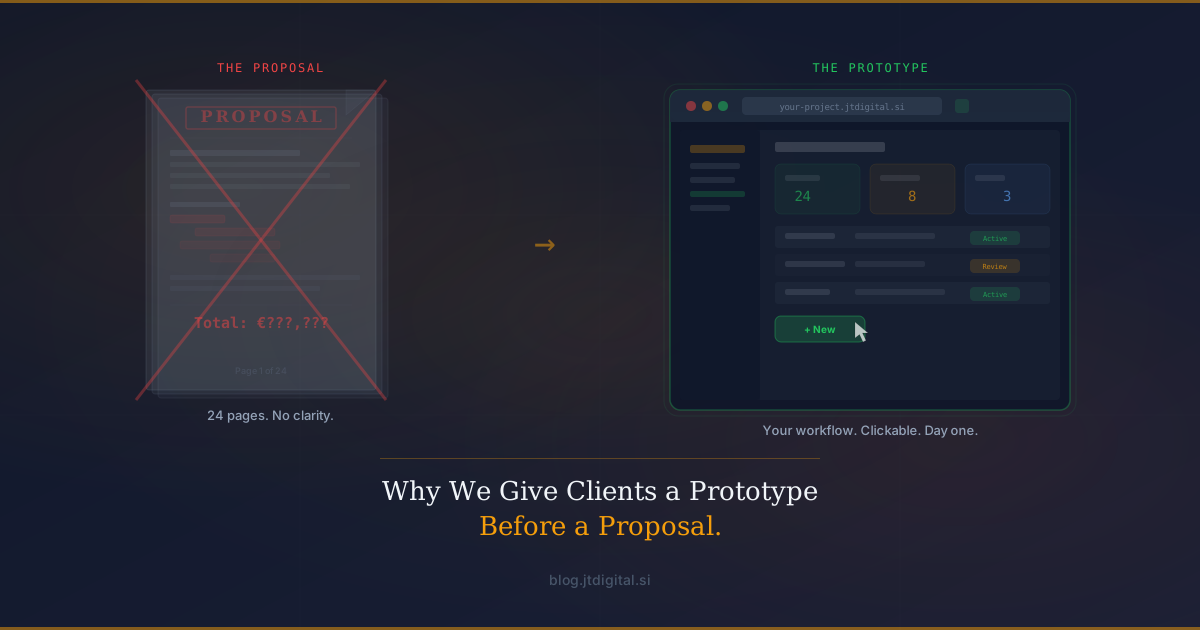
Not a mood board. Not a wireframe PDF with a watermark. A clickable, testable thing — built on the actual logic of your business — usually within 24 hours of the conversation. We've been told this is unusual. We think it should be standard.
The Problem With Proposals
A proposal is a document about confidence. It says: here is what we will build, here is what it will cost, here is how long it will take.
What it rarely says is: here is proof that we actually understood you.
- Beautifully formatted
- Cites methodologies
- Includes a Gantt chart nobody looks at
- Asks for money in exchange for clarity — later
- Keeps you in evaluation mode
- Something you can click and try right away
- Built on your actual business logic
- Rough design, real sequence
- Delivers clarity before money changes hands
- Ends evaluation mode immediately
We've read proposals from other agencies on behalf of clients who asked for our opinion. They are often beautifully formatted. They cite methodologies. They include Gantt charts that nobody will look at past week two. And they ask for a significant sum of money in exchange for the promise that clarity will arrive later.
We think that's the wrong order.
What Happens in 24 Hours
After a discovery conversation, we don't go away and write. We go away and build.
We listen for what we call the Red Line — the single most important workflow. The one that, if it worked better, everything else runs smoother.
Within 24 hours, we turn that Red Line into something you can click through and try immediately. No real data. Rough design. But the logic is real — and that's what matters.
You see your own process reflected back at you as a tool. Not a diagram of a tool. Not a description. The actual sequence of steps, decisions, and outputs your team deals with every day — made clickable.
And then, within thirty seconds, someone points at the screen and says "that part is wrong."
Why "Wrong" Is the Goal
When a client tells us something is wrong in a prototype, three things happen simultaneously.
They prove they understand what we built. They reveal something about their process they hadn't articulated in the meeting. And they move from evaluating us to collaborating with us.
A proposal keeps you in evaluation mode. A prototype ends it. By the time we do send a proposal, it isn't a pitch. It's a summary of decisions we've already made together.
The Honest Part
This approach costs us time upfront that we don't always recover. Some clients take the prototype, thank us, and disappear. We've made peace with that.
What we haven't made peace with is the alternative: charging clients for months of development on a foundation that was never validated, because everyone was too polite to stress-test the logic before the contract was signed.
The prototype is how we protect both sides of the table.
The problem probably wasn't the development.
It was the gap between what was written down and what was actually needed — a gap that nobody closed before the work began.
A prototype closes it in 24 hours. No contract required. No commitment beyond an honest conversation.
If your last software project started with a proposal and ended with something your team barely uses, the problem probably wasn't the development. It was the gap between what was written down and what was actually needed.
If that sounds like a conversation worth having — let's have it before anyone writes a single line of a proposal.